

Octane at UK Pinfest 2026
MAYA Pinball brought Octane, our patent-pending switchless closed-loop flipper technology, to UK Pinfest 2026 for its first public demonstration on hardware.

Nick C
Octane, MAYA’s next-generation flipper technology, had its first public outing within hours of filing the patent application. That’s why I’m catching up on the marketing activity that should have happened before the event now in the week that follows! If you missed the demo at the show, there’s a 2-minute video demonstration below. If you want to go in deep, there is a dedicated Octane section of this site.
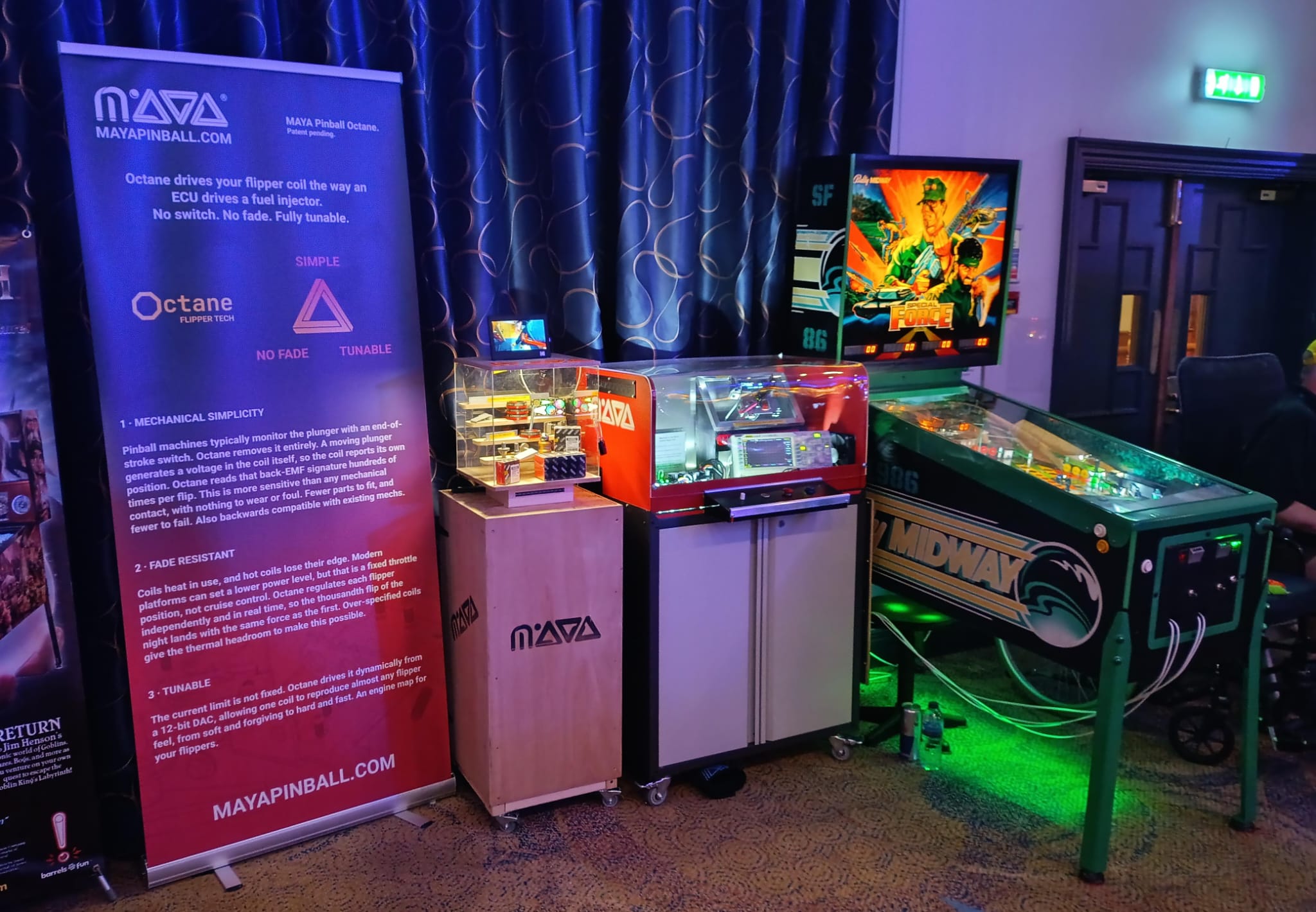
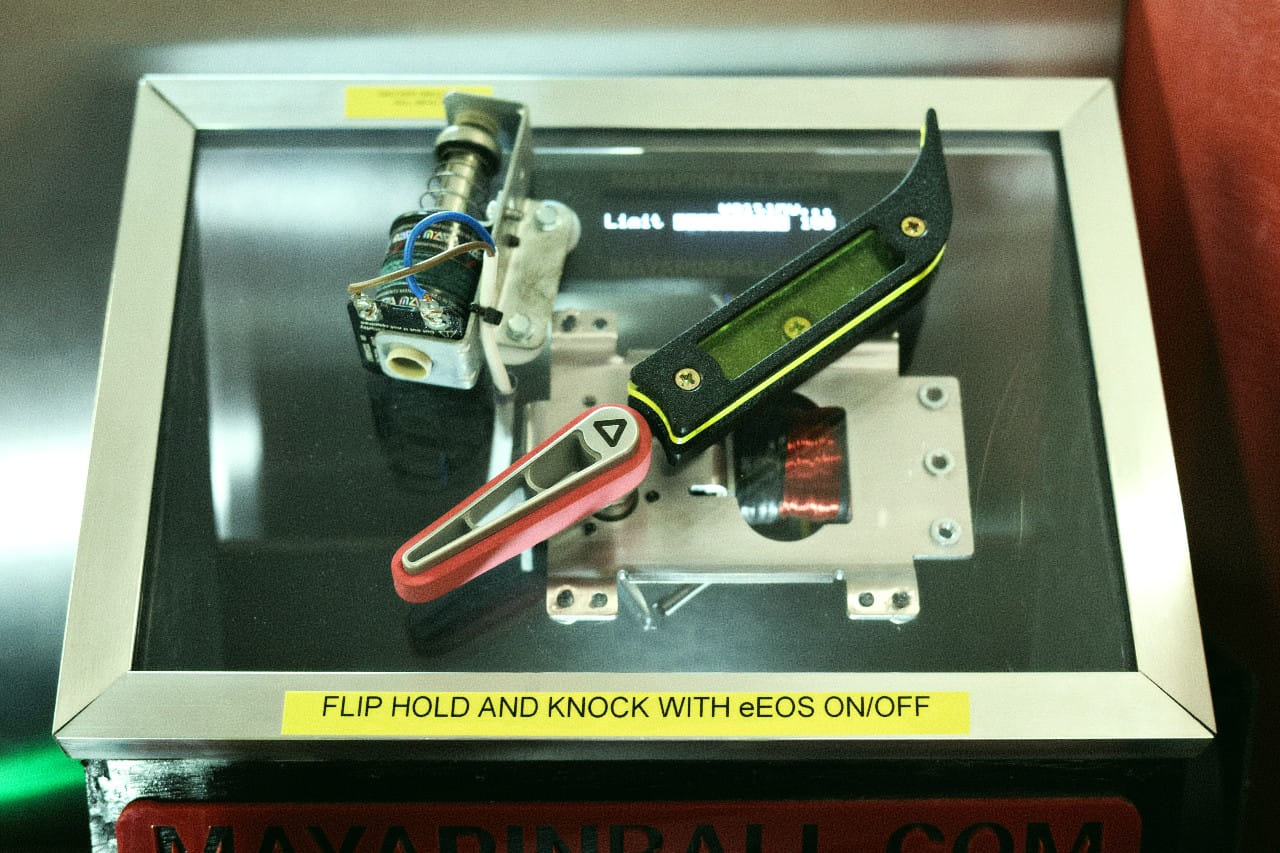
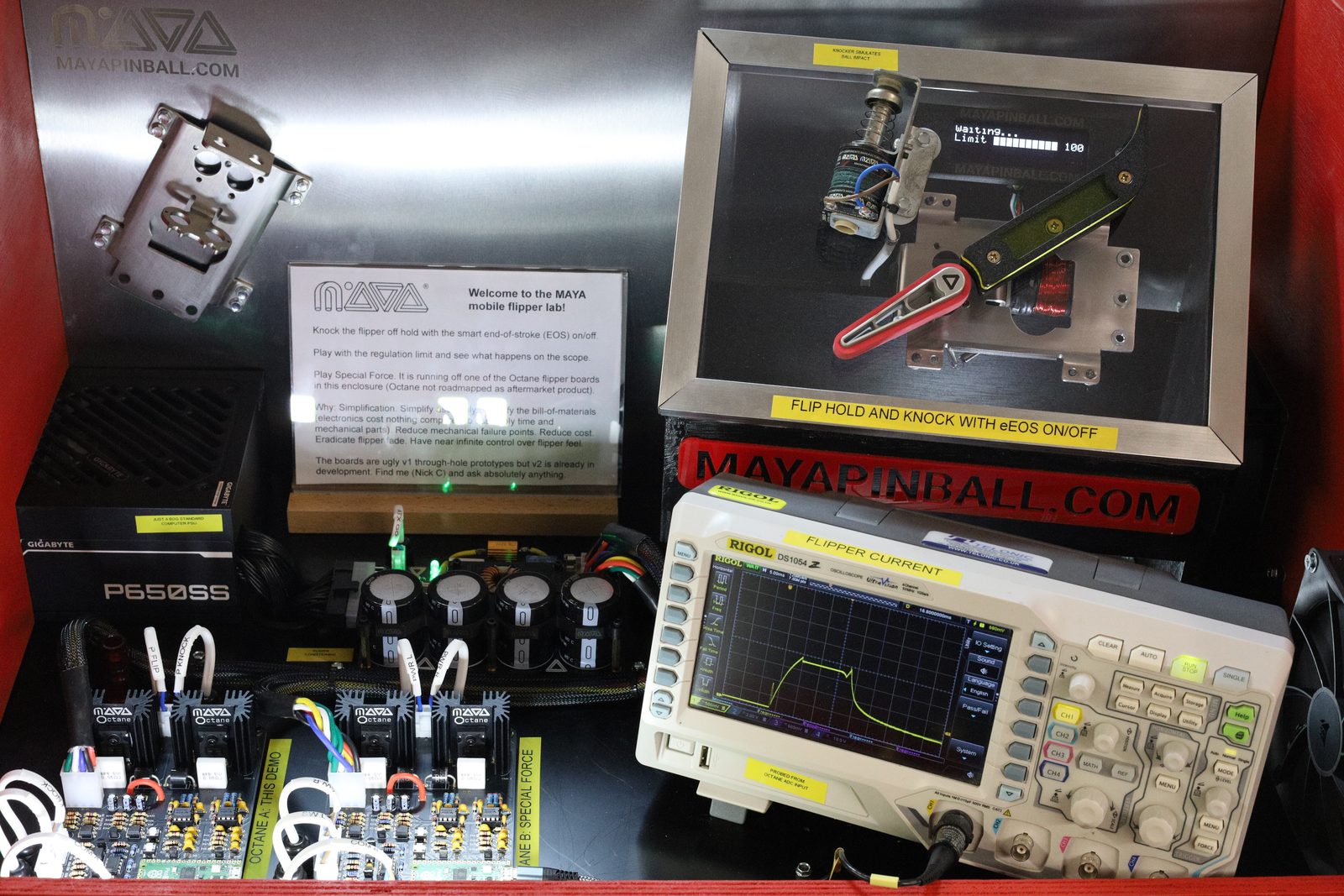
The setup was a cabinet enclosure housing a MAYA Pinball power conditioning board (more on innovations contained in this to come in a future writing), an oscilloscope to monitor what the brain of the each Octane flipper driver sees, and two Octane flipper driver boards. One drove a bare flipper and knocker rig for a self-contained demo of regulation and knock recovery. The other was wired into a classic pinball machine on the show floor, so attendees could actually play a full game on Octane-controlled flippers rather than just watch a bench demo.
The core demonstration was a direct comparison. With Octane disengaged, the flipper power stroke ran on a conventional fixed-pulse drive, the same approach used across most of the industry. After the main power stroke, the flipper is held at reduced power. Knock it in this low power state without any form of end-of-stroke (EOS) switch, and it simply gives way. This is why the industry typically still uses an EOS switch on flippers.
With Octane engaged, the same coil is driven differently. The controller reads end-of-stroke directly from the coil’s own current, with no mechanical end-of-stroke switch at all. Firstly, the flipper can reliably power down to a hold state when the initial EOS is detected. Moreover, when the flipper is knocked, it recovers much faster and with greater sensitivity than possible using a physical switch. The system is engineered to cost less to assemble, have fewer parts to fail, and be more responsive than any indirect method of plunger position sensing involving a switch.
The other half of the demo, more relevant to the player, covered closed-loop current regulation: a settable current target, rather than the fixed-voltage or duty-cycle approach used elsewhere. Down-regulating over-specified coils gives thermal headroom. This effectively eliminates flipper fade in a way that is simply not possible with a conventional open-loop flipper drive system. The underlying control loop can shape the current into an arbitrary profile, providing limitless options for flipper feel, which is where a lot of the future work is headed. Octane is functional, but not yet a finished product. Watch this space closely!
More detail on the platform is up at mayapinball.com/octane.
Share this post
Like this post? Share it with your friends!