

What Do the Numbers on a Pinball Coil Mean?
In 23-800, 23 is the wire gauge and 800 is the number of turns. How to read pinball coil labels and flipper part numbers, and what your coil should measure.

Nick C
In 23-800, 23 is the wire gauge and 800 is the number of turns. That’s the short answer. The longer one starts, as it usually does, with a coil in your hand.
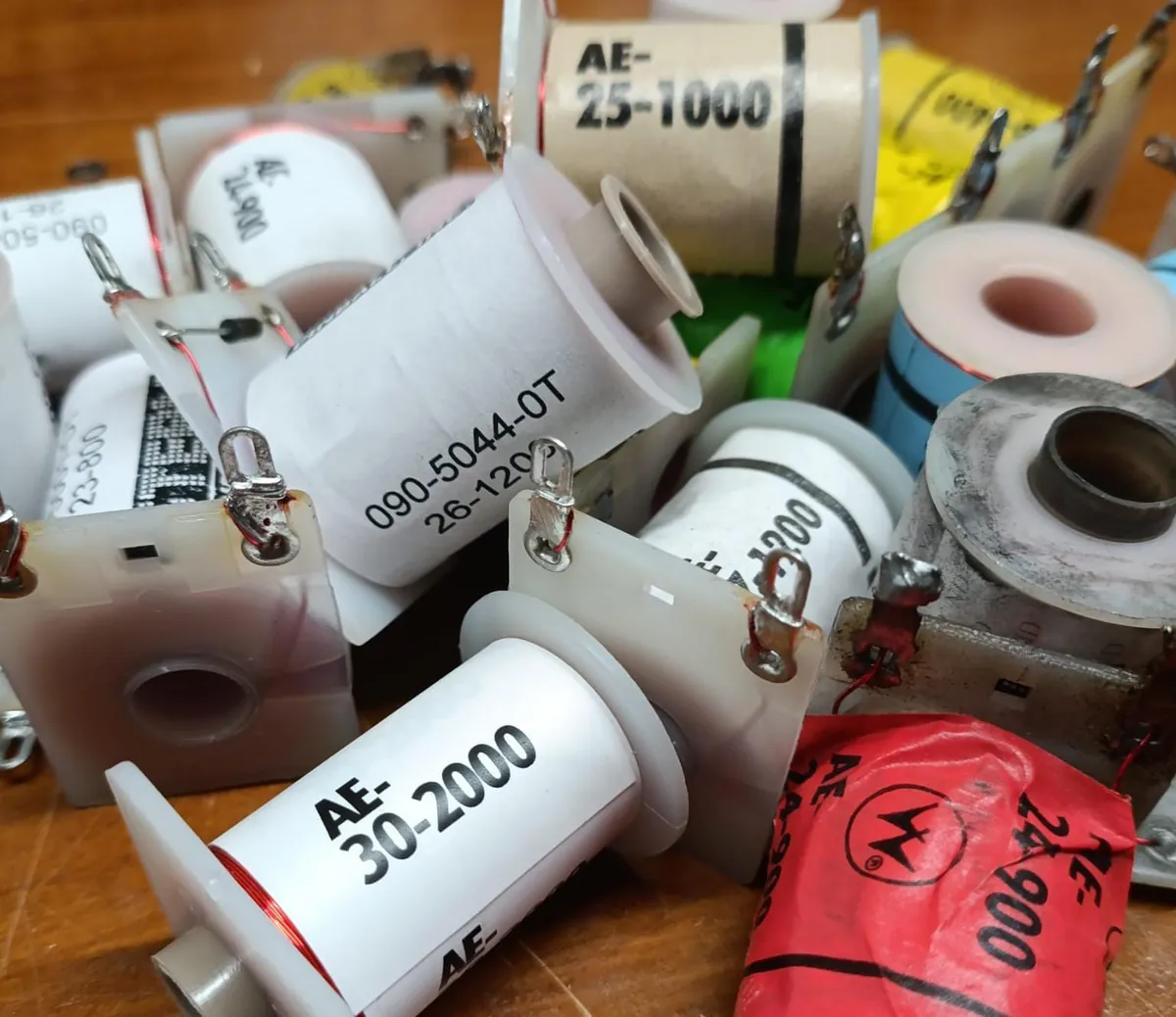
Something on the playfield has stopped working, you’ve traced it to a coil, and now you need to order another one. The label is your only clue. Sometimes it tells you everything. Sometimes it’s a part number that tells you nothing. And sometimes it’s scorched, torn or gone. We had 29 coils on the bench for our pinball coil chart, so here’s how to read the numbers, what to do when there aren’t any, and how to check the coil you’ve got.
How do you read a pinball coil label?
Grab the coil at the front of this heap, AE-30-2000, and read it backwards. 2000 is the number of turns of wire. 30 is the gauge of that wire. AE is the bobbin, the plastic spool it’s all wound on. Standard Williams and Bally playfield coils all work this way, so once you can read one, you can read the lot.
Data East, Sega and Stern do it differently. Their part numbers, like the 090-5044-OT in the middle there, say nothing about the winding, so the gauge and turns get printed on a line of their own: 26-1200.
Why is a bigger gauge number thinner wire?
Back to that 30. It’s the wire size, and it runs backwards: the bigger the number, the thinner the wire. AWG (American Wire Gauge) numbers started out counting how many times the wire had been pulled through a die, and every pull makes it thinner. So the 30 gauge wire in an AE-30-2000 is much finer than the 23 gauge in an AE-23-800. Every 3 gauge numbers roughly halves the copper and doubles the resistance of each metre.
That’s why the gauge matters so much. Finer wire means more ohms, less current and a gentler coil. The AE-30-2000 reads 38.5 Ω, and the AE-23-800 just 3.8 Ω.
It also means you can work out how much wire is in a coil without unwinding it: divide its resistance by the Ω per metre in the table below. An AE-26-1500 at 13.8 Ω has 103 m (339 ft) of wire in it. The hold winding of one of our flipper coils has 321 m, over a thousand feet of copper.
| AWG | Diameter (mm) | Diameter (in) | Area (mm²) | Area (circular mils) | Ω/m | Ω/1000 ft |
|---|---|---|---|---|---|---|
| 20 | 0.812 | 0.0320 | 0.5176 | 1022 | 0.0333 | 10.15 |
| 21 | 0.723 | 0.0285 | 0.4105 | 810 | 0.0420 | 12.80 |
| 22 | 0.644 | 0.0253 | 0.3255 | 642 | 0.0530 | 16.14 |
| 23 | 0.573 | 0.0226 | 0.2582 | 509 | 0.0668 | 20.35 |
| 24 | 0.511 | 0.0201 | 0.2047 | 404 | 0.0842 | 25.67 |
| 25 | 0.455 | 0.0179 | 0.1624 | 320 | 0.1062 | 32.37 |
| 26 | 0.405 | 0.0159 | 0.1288 | 254 | 0.1339 | 40.81 |
| 27 | 0.361 | 0.0142 | 0.1021 | 202 | 0.1688 | 51.46 |
| 28 | 0.321 | 0.0126 | 0.0810 | 160 | 0.2129 | 64.89 |
| 29 | 0.286 | 0.0113 | 0.0642 | 127 | 0.2685 | 81.83 |
| 30 | 0.255 | 0.0100 | 0.0509 | 101 | 0.3385 | 103.18 |
| 31 | 0.227 | 0.0089 | 0.0404 | 80 | 0.4269 | 130.11 |
| 32 | 0.202 | 0.0080 | 0.0320 | 63 | 0.5383 | 164.07 |
| 33 | 0.180 | 0.0071 | 0.0254 | 50 | 0.6788 | 206.89 |
| 34 | 0.160 | 0.0063 | 0.0201 | 40 | 0.8559 | 260.88 |
Bare copper at 20 °C (68 °F). Enamelled magnet wire is typically 0.01 to 0.03 mm larger than bare in these sizes, so 32 AWG measures about 0.22 to 0.23 mm (0.009 in) over the enamel.
Why do some flipper coils have two sets of numbers?
Flipper coils are where labels get interesting. A flipper has two jobs: kick hard, then hold the bat up for as long as you hold the button, without cooking itself. The traditional answer is two windings on one bobbin, a dual-wound coil. The power winding is thick wire and few turns, and it does the flip. The hold winding is wound over the top in thin wire with lots of turns, and takes over once the flipper is up.
Not every flipper coil works like that. In 1989 Data East switched to a single winding and let the electronics handle the hold, and Stern carried that on for most of its games since. The quick way to tell on the bench is to count the lugs: three lugs means two windings, two lugs means one.
What does FL-11629 mean?
Then Williams took the numbers off. Its WPC-era flipper coils, such as FL-11629, FL-11630 and FL-11753, carry a part number and nothing else. Williams kept the dual-wound coil right through that era, so there are still two windings in there. The label just doesn’t say what they are, and suppliers generally only publish the resistances.
What Williams did give us is a colour. The wrapper tells us where the coil sits in the range:
| Coil | Wrapper | Strength | Published resistance, power / hold (Ω) |
|---|---|---|---|
| FL-11753 | Yellow | Weakest | 9.8 / 165 |
| FL-11722 | Green | Weaker | 6.0 / 160 |
| FL-11630 | Red | Medium | 4.7 / 160 |
| FL-15411 | Orange | Stronger | 4.2 / 150 |
| FL-11629 | Blue | Strongest | 4.0 / 133 |
From the flippers.com master coil chart. Aftermarket coils often come in a light blue wrapper whatever their strength, so go by the part number, not the colour.
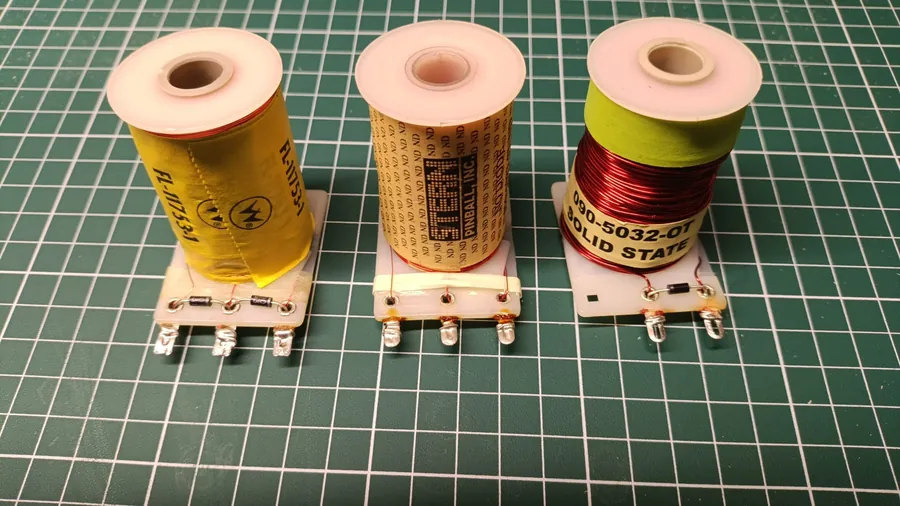
FL-11629’s winding is published, as 23-800/32-3000. The yellow FL-11753-1 in the photo isn’t, so we worked it out on the bench without unwinding it: about 26-1000/32-3800. More on how further down.
What do the letters mean?
Once you know the gauge and turns, you’re nearly ready to order. The last thing to check is the letters, because they’re about whether the coil fits, not how hard it hits. On Williams and Bally coils, the letters at the front give the shape of the bobbin, so two coils with the same letters fit the same space. They also tell you where the solder lugs and the diode sit, and get those wrong and the coil either won’t clear its bracket or ends up with its diode backwards.
| Code | Example | What it tells you |
|---|---|---|
| Williams and Bally | ||
| AE | AE-26-1200 | Lugs at both ends of the base |
| AL | AL-23-800 | Lugs on the left and middle (looking over coil with circular cap towards you with lugs at top) |
| AR | AR-26-1200 | Lugs in the middle and on the right (looking over coil with circular cap towards you with lugs at top) |
| FL | FL-11629 | Flipper coil |
| SA and SG | SA-23-850-DC, SG-23-850-DC | Older Williams: the same coil, but an SA has its sleeve fitted the other way round |
| -01, -05, -06 | AE-23-800-01 | Diode on top of the lugs |
| -02, -03, -04 | AE-23-800-02 | Diode underneath the lugs |
| -07 | AE-23-800-07 | Diode on top, comes with a flanged sleeve |
| -08 | AE-23-800-08 | Lugs bent at 90°, for a Midway gun game |
| Data East, Sega and Stern | ||
| OT | 090-5044-OT | Diode on top, on the winding side of the lugs |
| OB | 090-5044-OB | Diode on the bottom |
| ND | 090-5083-03-ND | No diode on the coil |
| Gottlieb | ||
| A- | Every Gottlieb coil starts with A-, whatever its size |
The number on the end of a Williams or Bally coil doesn’t change the winding. So why three numbers for a diode on top? Each one replaced a different older Williams coil, and those came with different sleeves. So,they are all the same underlying coil today. Just match the diode to your old one, and buy the correct sleeve separately if your mech needs a new one.
On Data East, Sega and Stern coils the number itself tells you nothing about the winding. A 090-5020-20 flipper coil is 22-900 and a 090-5020-30 is 23-900, but that’s just those two parts, so look the number up rather than trying to decode it.
The diode is the one to take seriously. Wire a coil up with its diode the wrong way round and you can take out a fuse or a driver transistor, so check which way the band faces before you solder anything.
If the old coil is already out of the game and you didn’t take a note or a photo, don’t panic. In solid state games most coils are switched on the low side, so one lug gets the supply voltage and the driver pulls the other lug to ground. The supply is normally the side that’s daisy chained from coil to coil, and the band on the diode goes to that lug. Double check with a voltmeter if you are unsure.
What should my pinball coil measure?
Whether you’re checking a suspect coil or making sure the new one is what the label says, start with resistance. Here’s what known-good coils read on our bench, cold at 20 °C (68 °F):
| Coil | Resistance (Ω) |
|---|---|
| AE-23-800 | 3.77 |
| AE-24-900 | 5.11 |
| AE-26-1200 | 10.40 |
| AE-30-2000 | 38.49 |
| 090-5020-20T (22-900) | 3.41 |
| FL-11629 power / hold | 4.01 / 126.9 |
That’s just a handful of common ones. All 29 coils we measured are in our pinball coil chart, and for anything we haven’t got, the flippers.com master coil chart lists published resistances for over a thousand coils.
Getting a reading you can trust takes a bit of care:
- Zero your leads. Touch the probes together and note the reading. On a 4 Ω flipper power winding, a few tenths of an ohm in the leads is a big error, so subtract it. A proper 4-wire bench meter avoids the problem altogether.
- Measure cold. Copper’s resistance goes up about 0.4 % per °C, so a coil straight out of a long game will read noticeably high.
- Watch the diode. Most coils have a diode across them. If your meter’s test voltage forward-biases it, the reading comes out low. Swap the probes over: the higher of the two readings is the coil. If in doubt, lift one end of the diode.
- Dual-wound coils: one winding at a time. Measure across each pair of lugs. The hold winding reads in the hundreds of ohms and the power winding in single figures, so it’s obvious which is which. On an older series-wound flipper coil still in the machine, the end-of-stroke switch sits across the hold winding, so with the switch closed you’ll only read the power winding.
- Compare like with like. A reading within a few percent of a known-good twin is fine. Our same-model pairs agreed within about 1 %.
What if the label’s missing, or wrong?
The sensible answer is to open the manual. The parts list will give you the coil for every position on the playfield, and you’ll have your replacement ordered before the kettle’s boiled.
But if the manual’s long gone, the coil doesn’t match it, or you’re just the sort of person who owns an LCR meter, there’s a more fun way. Resistance tells you about the gauge and the turns together, but it can’t pull them apart: more turns of thicker wire can read the same as fewer turns of thinner wire. To separate them you need a second measurement, and that’s inductance.
Inductance is how strongly a coil resists a change in the current flowing through it. An LCR meter measures it, and a cheap one will do. The useful thing about it is that it depends on the turns, not the wire. Double the turns and the inductance goes up four times, whatever gauge they’re wound in.
Push a flipper plunger fully into the coil first. The iron roughly triples the reading (an AE-26-1200 goes from 10 mH empty to 35 mH), and it’s how we measured every coil in the chart. With the plunger in, every standard playfield coil we measured came out at about 24.5 nH per turn squared. So you can count the turns:
turns ≈ √(inductance ÷ 24.5 nH)
A coil reading 35 mH works out at about 1200 turns, which is exactly what an AE-26-1200 should be. Expect about ±5 %. Once you know the turns, the resistance gives you the gauge, and you’ve got your label back. That’s how we worked out the FL-11753-1, and the full method is in the coil chart.
It doesn’t work for everything. Stern’s flipper coils are built differently and come out about 20 % lower per turn, so a Stern 23-900 reads almost exactly the same as a Williams 23-800.
A coil with one turn shorted to its neighbour has lost one turn in 800, so its DC resistance moves by about 0.1 %. A good bench meter can resolve that, but it won't tell you anything: a quarter of a degree of warmth moves the reading as much, and two good coils of the same model can differ by 1 %. The shorted turn does something much bigger at AC, though: it acts like a short-circuited secondary winding, fighting any change in the field. Inductance drops, sometimes dramatically, and the coil gets weaker and runs hotter.
An LCR meter catches it. Compare the inductance against a known-good twin or against the AL rule in our coil chart. Check the test frequency too: some meters switch themselves to a higher frequency on small coils, and with the plunger in that can read less than half the true value, which looks just like a shorted turn.
So which is stronger, a 23-800 or a 26-1200?
The 23-800, comfortably. It’s wound with thicker wire, so there’s more copper in it: 134 g against 89 g for the whole coil on our scales. In the simple steady-state sums, which ignore inductance, it manages about 10200 ampere-turns at 48 V against 5500 for the 26-1200. Ampere-turns are the current times the number of turns, and they’re the easy way to compare how hard two coils pull.
The obvious follow-up is whether you can make a coil stronger just by lowering its resistance, say by pulling some turns off it. Many of us have done exactly that, and it does work, up to a point. Does a lower resistance pinball coil hit harder? goes into why, and where it stops working.
Share this post
Like this post? Share it with your friends!