
A Technical History of the Pinball Flipper, Part 3: Williams FlipTronics and the Switch as Feedback
How Williams kept the dual-wound coil, moved flipper control onto the board, and turned the end-of-stroke switch into position feedback.
Introduction
Part 2 followed Data East’s route out of the mechanically switched flipper. Data East changed the coil, replacing the two traditional windings with one winding fed at two different voltages. Williams took the other route. It kept the familiar dual-wound coil, but changed the way that coil was controlled.
That system was FlipTronics. Introduced on The Addams Family in 1992, it brought the flipper under computer control without abandoning the old power-and-hold coil. The end-of-stroke, or EOS, switch remained in the mechanism, but it no longer carried the heavy coil current. Its job changed from switching power to reporting position.
That distinction matters. FlipTronics shows that the move away from mechanical flipper control did not have to mean a new coil. In Williams’ case, the coil stayed. The circuit around it changed.
Before FlipTronics: the dual-wound coil inside the solid-state machine
As Part 1 described, the arrival of solid-state game logic did not immediately change the flipper. The standard arrangement still used two windings, a power winding and a hold winding, with a normally-closed EOS switch that opened at the end of travel to drop the coil to its hold level .
Williams refined that arrangement during its late solid-state years. During System 11, the company moved from the older series-wound arrangement to the parallel FL-11630 style, beginning around F-14 Tomcat. Earlier System 11 games such as High Speed through Millionaire had used the series-wound FL23/600-30/2600 style .
The change reduced arcing, but it did not remove the EOS from the power path. The high-current side of the flipper circuit still passed through a tungsten contact under the playfield. On the higher-voltage System 11 games, Williams also fitted a 2.2 microfarad capacitor across the EOS contacts to help tame the arc, as covered in Part 1. The rest of the machine was solid state, but the flipper was still, in this important respect, mechanically switched.
FlipTronics arrives, 1992
FlipTronics changed that. It was introduced on The Addams Family, released in March 1992 under the Bally label on the Williams WPC platform . The first board, now usually called FlipTronics I, appeared on only two games: The Addams Family and The Addams Family Gold.
Every WPC game after that used the FlipTronics II board, until WPC-95 absorbed the flipper electronics into the main power and driver board and the separate FlipTronics board disappeared. Through those changes, Williams retained the dual-wound coil. The standard FlipTronics mechanism used the FL-11630 coil . What changed was not the coil, but who controlled it.
How FlipTronics works
In a FlipTronics game, flipper power is present at the coil lugs. The board fires the flipper by completing a path to ground for the appropriate winding, under control of the processor.
When the player presses the cabinet button, the switch-sensing circuitry reports that closure to the processor. The processor then tells the flipper board to ground the power winding. The power stroke is driven through a TIP102 transistor acting as a pre-driver for a higher-current TIP36. After a short interval, the processor interrupts the power-winding ground and grounds the hold winding instead. The hold winding is driven through a TIP102 alone. When the player releases the button, the board sees the switch open and removes the hold ground, allowing the flipper to fall back to rest .
The important shift is the kick-to-hold transition. It is no longer performed by the EOS switch opening a high-current circuit. It is performed by the electronics, which switch the ground path from one winding to the other. The coil still has separate power and hold windings, but the decision about when to leave one and use the other has moved onto the board.
The EOS becomes a signal
The change in the EOS switch is visible in two places: its resting state and its contact material.
Before FlipTronics, the EOS switch was normally closed. It carried current through the power winding until the flipper reached the top of its stroke. At that point the switch opened and the circuit dropped to hold. On FlipTronics games the EOS is normally open. It closes when the flipper reaches the top, telling the processor that the stroke has completed .
Williams treated that reversal as important enough to label. The Addams Family playfields carried a small card under the playfield warning that the EOS switch was now normally open, unlike the earlier high-power EOS switches used on previous Williams and Bally games. The same label appeared on subsequent WPC Fliptronics II games.
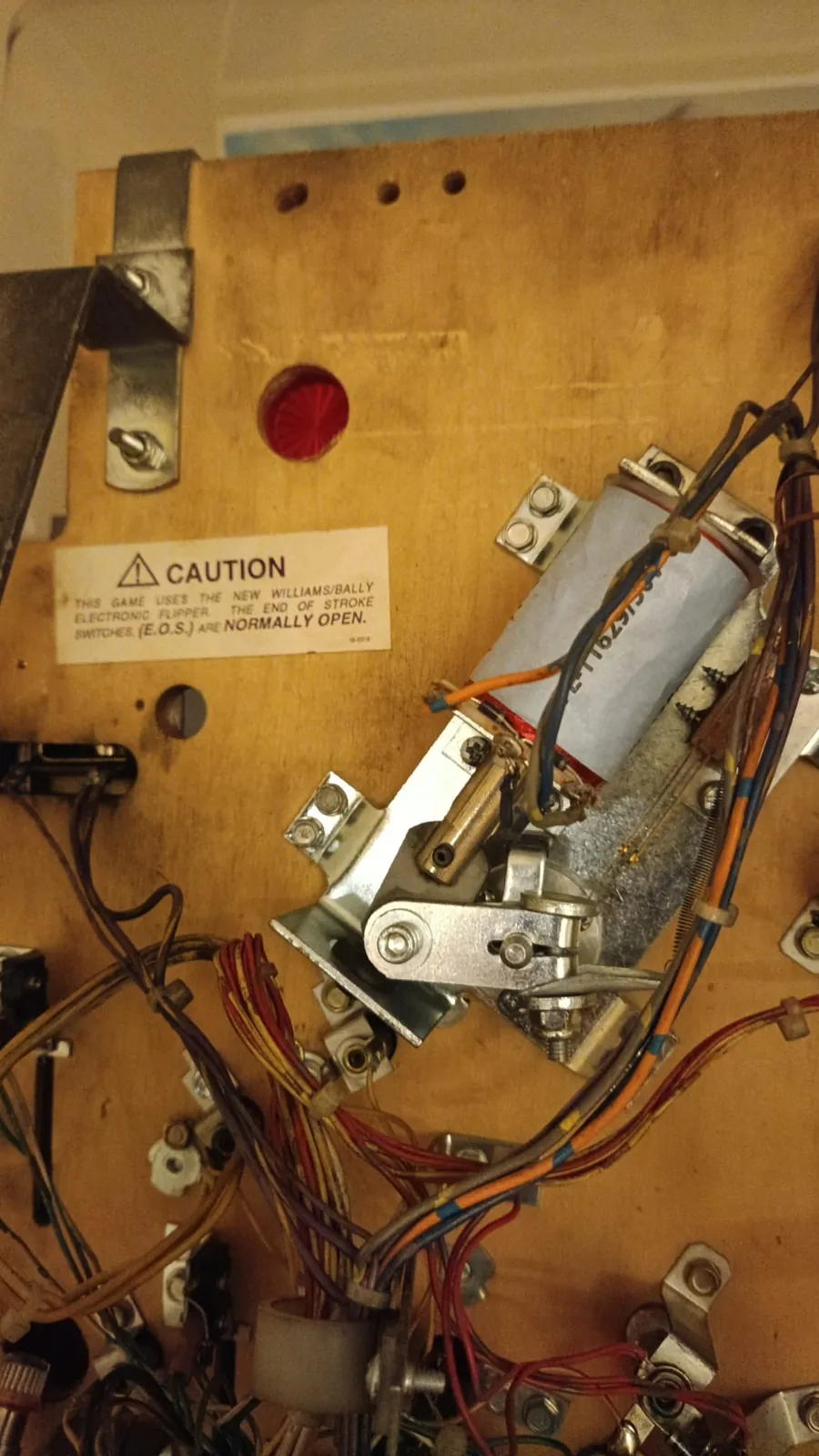
The contact material tells the same story. A mechanically switched EOS needed tungsten contacts because it had to break high current. A FlipTronics EOS does not. It is a low-power, gold-plated switch, and it should not be filed . There is no high-current arc to clean up, and no need for the 2.2 microfarad arc-suppression capacitor used on the earlier System 11 flippers.
Electrically, the switch has become a logic input. On pre-WPC-95 games the EOS inputs are handled through the FlipTronics board. On WPC-95, the EOS switch inputs go to the CPU board at connector J208, with the cabinet flipper optos handled separately. The FlipTronics II board also carries its own flyback diode to protect the transistors from the coil’s back-EMF, so in principle the diode on the coil is redundant, although in practice the coils still carry one.
Why Williams kept the switch
Once the normal kick-to-hold transition was handled by electronics, the EOS switch might seem unnecessary. Williams kept it because timing can only solve part of the problem.
The first job is stroke confirmation. If the processor does not receive the EOS feedback it expects, perhaps because the switch has failed or is misadjusted, a timeout interrupts the power winding anyway after a set interval. A failed EOS therefore no longer leaves the power winding energised long enough to cook the coil.
That timeout can protect the coil during a normal stroke, but it cannot detect what happens afterward. If a fast ball strikes a raised flipper and forces it down off its stop, the normally-open EOS reopens. FlipTronics responds by grounding the power winding again, driving the flipper back up until the EOS closes once more.
This is knock recovery. It cannot be handled by a fixed timer because the knock is not part of the firing sequence. It can happen after the flipper is already up, and it depends on what the ball does. To recover from it, the machine needs live information about the actual position of the flipper. That is what the EOS switch provides.
So FlipTronics did not eliminate the EOS. It gave it a narrower job. The switch no longer carried power, no longer needed tungsten contacts, and no longer needed an arc-suppression capacitor. It remained because it could tell the game something the timer could not: the flipper had moved.
Two approaches, same result
Data East and Williams reached the same broad result from different directions. Data East changed the coil first, then used electronics and timing to manage the power stroke and hold. Williams kept the dual-wound coil and moved the switching around it onto the board.
In both cases, the EOS switch lost its old job as a power-handling contact. What remained was feedback. The machine still needed to know when the flipper had completed its stroke, and more importantly, when a ball had knocked a raised flipper down. By the mid-1990s, the flipper’s power was being controlled electronically, while the EOS switch survived as a position signal.
Part 4 follows the single-wound lineage forward through Stern’s WhiteStar, S.A.M., and SPIKE systems.
References
PinWiki, Williams WPC (FlipTronics I on The Addams Family and The Addams Family Gold only; FlipTronics II thereafter; WPC-95 integration; pre-FlipTronics dual-wound circuit; the EOS as information only; the timeout fallback; and the knock-recovery sequence in which the board re-grounds the power winding until the EOS recloses).
Wikipedia, The Addams Family (pinball) (Midway/Bally, March 1992, Williams WPC, FlipTronics I).
Marco Specialties, Williams FlipTronics flipper mechanism assembly A-15205-R (FL-11630 coil) (the dual-wound coil retained under FlipTronics).
homepinballrepair.com, How Solid-State Flippers Work: FlipTronics, DE/Sega/Stern (TIP102 pre-driver and TIP36 power transistor; the FlipTronics II board flyback diode; EOS to the CPU at J208; WPC-95 Schmitt-trigger optos).
Pinside, Normally Open / Normally Closed EOS Switch, Bally Williams (FlipTronics EOS is normally open; the warning card stapled under The Addams Family playfield noting the change from high-power EOS blades).
homepinballrepair.com, How Pinball Flippers Work (Williams’ move from series to parallel coils during the System 7 era; FlipTronics from The Addams Family).
homepinballrepair.com, Rebuild Williams / Bally WPC FlipTronics Flippers (FlipTronics EOS switches are normally open, low power, and gold-plated, and should never be filed).
This is Part 3 of a technical history of the pinball flipper. Part 4 follows the single-wound lineage forward through Stern’s WhiteStar, S.A.M., and SPIKE systems.