
A Technical History of the Pinball Flipper, Part 4: Stern’s Node-Controlled and PWM Era
How Stern carried the single-wound flipper through WhiteStar, S.A.M., and SPIKE, and why the EOS switch survived after software took over the hold.
Introduction
The single-wound coil that Part 2 traced to Kurt Deger did not end with Data East. It passed through Sega and into Stern. Data East’s pinball operation became Sega Pinball in 1994, and Sega Pinball became Stern Pinball in 1999. Stern inherited that flipper lineage and carried it through WhiteStar, S.A.M., and SPIKE.
Those systems differ in their boards, drivers, and coils, but they share one important break with the mechanically switched flipper. The normal transition from power stroke to hold is no longer made by an EOS switch opening a high-current circuit. In the single-wound systems, software gives the coil a timed full-power kick, then holds the flipper up with short pulses. SPIKE 1 briefly returned to dual-wound coils, but the control was still electronic rather than a simple mechanical EOS handover.
The EOS switch survived anyway. It survived because timing can handle the normal stroke, but it cannot know when a ball has knocked a raised flipper off its stop. For that, the game still needs a position signal from the flipper itself.
WhiteStar: mid-1990s to 2006
WhiteStar, used first by Sega and then by early Stern, drove a single-wound flipper coil with no separate hold winding . A single winding cannot be left on at full power without overheating, so the computer gives it a hard initial pulse and then keeps it up with much shorter pulses.
The change from the earlier Data East and Sega arrangement is simple but important. The older boards used 50 V for the power stroke and a separate low-voltage supply for hold. WhiteStar used a single 50 V supply. The power stroke was a 40 millisecond pulse. Hold was produced by switching the same 50 V on for only 1 millisecond in every 12, enough to keep the flipper raised without cooking the coil .
That means the EOS switch was no longer deciding when to drop from kick to hold. The timer and pulse train did that. The EOS had a different job: foldback.
During hold, a hard shot can push the raised flipper down far enough to reclose the EOS. When that happens, the game applies another full 50 V pulse for 40 milliseconds and drives the flipper back up. A WhiteStar flipper can still flip with a bad EOS, but it loses that recovery. If the switch is missing or badly adjusted, a hard hit can force the flipper closed and trap or drain the ball.
This is the key point about WhiteStar. It did not use the EOS in the old sense, as the switch that performed the kick-to-hold change. The EOS was already a position signal used for foldback. The single-wound coils still carried a diode, and from the Goldeneye era onward the flipper cabinet switches and EOS switches were dedicated processor inputs rather than ordinary switch-matrix entries. Later WhiteStar games, including Lord of the Rings, even allowed the operator to adjust flipper strength by changing the power-stroke timing.
S.A.M.: 2006 to around 2015
Stern’s S.A.M. system continued the WhiteStar approach and made it cleaner. The flipper coil is still single-wound. The game delivers a full-power kick, then duty-cycles the coil in software to hold the flipper up. The EOS switch tells the game when the flipper has been pushed down far enough to need another kick .
One practical difference is the coil diode. On WhiteStar and the earlier Data East and Sega boards, the flipper coils carried diodes. On S.A.M., the board handles the coil’s back-EMF, so the flipper coils do not need them. That is sometimes treated simply as a maintenance convenience, since it removes the familiar problem of installing a diode-backed coil with the wires reversed. In the faster PWM systems that follow, however, the diode question becomes an electronics problem as much as a service problem.
The coils are switched by power MOSFETs and are never meant to be held at full power. One example often discussed by Stern owners is Metallica, which uses an STP22NE10L MOSFET driving a roughly 3.8 ohm coil, part 090-5020-30. At 50 V, that coil would draw on the order of 13 A if it were left on continuously, so it has to be pulsed . By the S.A.M. era, the single-wound, software-held flipper with an EOS used for foldback was Stern’s standard design.
SPIKE 1: a brief return to dual-wound coils
SPIKE distributed more of the control electronics into node boards around the cabinet and playfield. With the first SPIKE generation, Stern made a choice that looks surprising against the long single-wound story: it returned, for a short time, to dual-wound flipper coils under computer control.
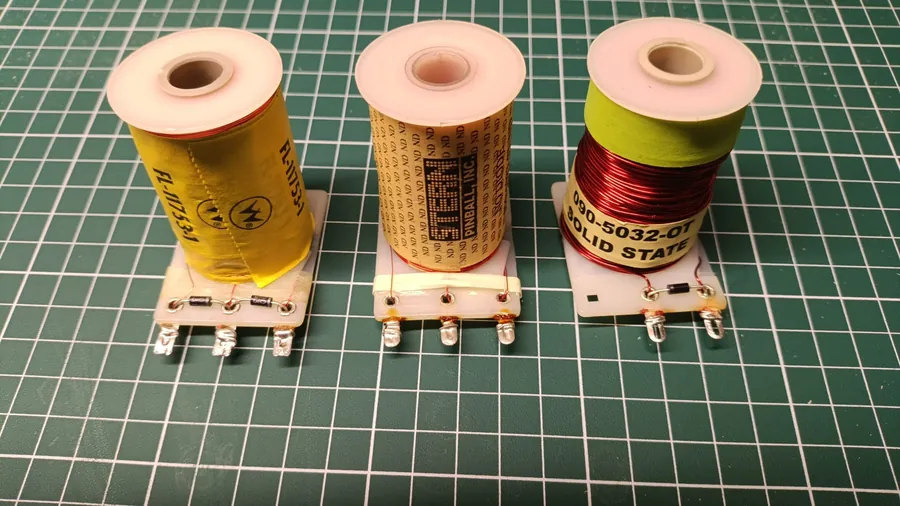
The documented replacement coil for these early SPIKE games, part 090-5083-03-ND, is a dual-wound flipper coil supplied without a diode . WWE Wrestlemania is identified as the first full production game on the SPIKE board set, and parts listings associate that dual-wound coil with early SPIKE titles including Whoa Nellie, WWE Wrestlemania, and KISS .
The safest claim is a narrow one. SPIKE 1 used dual-wound coils on the games for which the parts data confirms it. The published parts lists are not exhaustive, so it is better not to turn that into a definite list of every SPIKE 1 title. Stern does not appear to have published a detailed explanation for the detour, and the change became part of the wider hobby debate about single-wound versus dual-wound flippers.
What matters for this history is that SPIKE 1 did not return to the old mechanically switched flipper. It briefly returned to two windings, but not to a high-current EOS switch deciding the stroke.
SPIKE 2: back to single-wound PWM control
The dual-wound detour was brief. With SPIKE 2, beginning around Batman ‘66 and Aerosmith, Stern returned to single-wound flipper coils held under software control. Aerosmith, for example, uses a single-coil-style flipper coil, part 090-5030-ND.
Independent hobbyist reverse-engineering has measured the behaviour of a SPIKE 2 game in more detail. On a Teenage Mutant Ninja Turtles machine, the reported power stroke was roughly 36 milliseconds, switched at about 17 kHz, with duty cycle varying according to the configured flipper power. The hold was also pulse-width modulated, with a duty cycle of about 12 per cent. Those figures should be treated as game and firmware specific, but the general architecture is familiar: a timed power stroke followed by a modulated hold.
In that sense, SPIKE 2 returns to the line that runs from WhiteStar through S.A.M. The board technology is newer, the control is finer, and the electronics are distributed differently, but the basic idea is the same. A single coil is given a hard timed kick, then held with pulses.
Faster PWM changes the diode problem. In an older coil circuit, a diode mounted directly across the coil was a simple local flyback clamp. That is not the same job as flyback management in a fast PWM flipper drive. A normal 1N4007-class silicon rectifier is a general-purpose PN diode, not a fast switching part. At PWM rates, reverse recovery can leave that diode conducting at the wrong moment, adding current spikes, ringing, switching loss, and EMI.
Stern's own 520-7017-72D Core Node Hall 3amp schematic shows the later approach. The coil-drive sheet uses SK510A-LTP Schottky rectifiers as the flyback parts on the driver outputs, and it marks channels 0, 5, 6, and 7 as supporting high-frequency PWM operation, with all flippers to be connected to those outputs . The SK510A is a 5 A, 100 V Schottky rectifier, a much more appropriate device for this job than a general-purpose 1N4007-style diode . The absence of a diode on later Stern flipper coils should not be read only as a maintenance convenience or as a way to avoid reversed coil diodes. In a PWM-driven system, the flyback path has become part of the board-level switching design.
What stayed the same
WhiteStar, S.A.M., SPIKE 1, and SPIKE 2 look different on the bench. The coils change. The drivers change. The boards move from centralised control to node boards. One generation removes the coil diode; another briefly returns to dual windings. But the old EOS handover does not come back.
In the single-wound systems, WhiteStar, S.A.M., and SPIKE 2, the normal stroke is controlled by timing and a duty-cycled hold. In SPIKE 1, the coil is dual-wound again, but the control is still electronic rather than mechanically switched. Across the whole Stern lineage, the EOS switch is not there to carry flipper power. It is there to report where the flipper is .
That is why the switch has proved so hard to remove. The kick-to-hold transition is predictable. Software can time it. A ball strike is not predictable. It can happen at any point while the flipper is held up, and the controller cannot infer it from the original stroke timing. It needs a live indication that the flipper has moved. For most of the history covered in this series, that indication has come from the EOS switch.
By the modern Stern era, the EOS has lost almost everything it once did. It no longer carries the full coil current. It no longer decides the normal transition from power stroke to hold. It no longer needs to be a high-current tungsten contact. What remains is position feedback, especially foldback detection when a raised flipper is knocked off its stop.
That leaves one final question. If the EOS switch is now only a position sensor, does that position sensor still have to be a mechanical switch?
References
PinWiki, Sega/Stern White Star Repair (single-wound coil with no hold winding; the computer cycles the coil to hold; flipper cabinet and EOS switches as dedicated inputs after Goldeneye).
homepinballrepair.com, Fix Sega and Early Stern Flippers, WhiteStar (single 50 V supply; 40 millisecond power stroke; hold of 1 millisecond in every 12; the EOS used for foldback and re-kick, not kick-to-hold; later operator-adjustable power-stroke timing on games such as Lord of the Rings).
PinWiki, Stern S.A.M. System Repair (full-power kick, then a software duty-cycled hold; the EOS used to tell the game when to re-kick; no coil diodes required).
Pinball Info forum, Heads Up For Stern Owners (single-wound coils switched by power MOSFETs such as the STP22NE10L; the Metallica coil 090-5020-30 at about 3.8 ohms; the dual-wound versus single-wound debate).
Pinball Life, Stern 090-5083-03-ND flipper coil (a dual-wound SPIKE flipper coil without a diode; associated titles include Whoa Nellie, WWE Wrestlemania, and KISS; parts listing not exhaustive).
Mission Pinball Framework, Dual-wound versus single-wound coils, and Stern game manuals (the SPIKE 2 single-coil flipper coils, for example Aerosmith part 090-5030-ND).
PinWiki, Common Flipper Troubleshooting (single-wound coils on later Data East, Sega, and Stern games before the 2015 titles; computer-controlled end-of-stroke detection; the EOS retained to detect a ball pushing the flipper down).
Stern Pinball, 520-7017-72D Core Node Hall 3amp schematic, sheet 4, “Coil Drives” (SK510A-LTP flyback diodes on coil-driver outputs; channels 0, 5, 6, and 7 marked as supporting high-frequency PWM operation and as the required flipper outputs).
SMC Diode Solutions, SK510A Schottky Rectifier datasheet (5 A, 100 V Schottky rectifier; low forward voltage drop; high-frequency operation).
This is Part 4 of a technical history of the pinball flipper. Part 5 takes up the question this one leaves open, whether the end-of-stroke switch’s last remaining job can be done without the switch.