

A Technical History of the Pinball Flipper, Part 6: Regulating the Flip in Software
Once a controller is already reading coil current to sense the plunger, it is equally positioned to shape that current. Flipper feel, once a fixed consequence of a chosen coil and supply voltage, becomes a setting.
Introduction
Part 5 established that a flipper controller can read the plunger’s position directly from the coil’s current, closing a loop that used to depend on an end-of-stroke (EOS) switch. That loop runs in both directions. A controller sensitive enough to catch the small perturbations used for flipper position sensing, is also by construction, watching the current closely enough to modulate power to any target. The same measurement is not just there to read the flip, but to drive it. Part 6 covers more of the exciting possibilities opened up by the MAYA’s patent pending Octane platform.
Throttle position, or cruise control
Adjusting flipper strength in software is not new. The established way to do it is duty-cycle modulation: the drive is switched on and off within the power stroke, and the average voltage the coil sees is set by the fraction of time it spends on. This is an open-loop adjustment. It sets an input, the applied voltage, and trusts that a given input produces a given output. It does not know or care what current is actually flowing. That is throttle position: press the pedal a fixed amount and the car’s speed still depends on the hill, the load, and the engine condition on the day.
A coil driven this way still heats over a session, its resistance still rises, and for a fixed applied voltage a hotter coil draws less current and delivers a weaker stroke. Reducing the duty cycle reduces how much that happens, because less power is going in to begin with, but it does not stop it. The flipper turned down in software still fades, only from a lower baseline.
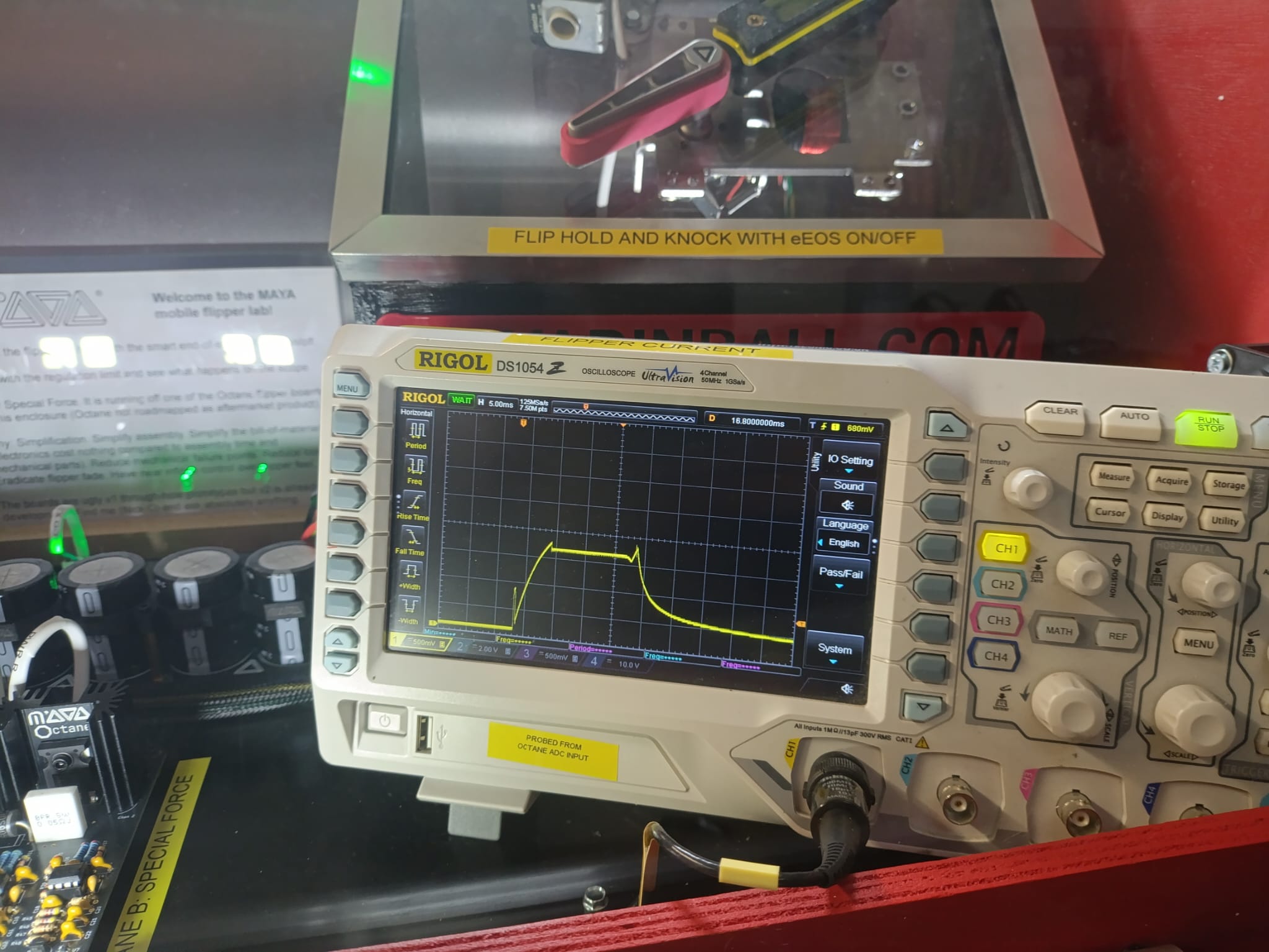
Closed-loop current regulation is a different kind of adjustment entirely. Rather than commanding a voltage and hoping the resulting current lands where it should, the controller commands a current directly, using the same sensed signal that already relegated the EOS switch, and continuously adjusts whatever it controls, whether that is a duty cycle or a linear regulating element, to hold that current at the target regardless of what the coil’s resistance happens to be doing. This is cruise control: set a target speed, and the car opens the throttle further on the uphill and eases off on the downhill, without the driver doing anything, so that what the driver experiences stays constant even though the underlying conditions did not. A regulated flipper stroke behaves the same way. As the coil warms through a session, the loop simply drives it a little harder to hold the same target current, and the delivered force stays where it was set, right up until the coil runs out of headroom to give.
That headroom is not free, and it is the price of the whole arrangement. A regulator can only hold a current down to a target it can actually reach; it cannot conjure current the coil and its supply are no longer capable of delivering. A coil intended to be regulated is therefore deliberately over-specified, wound with a heavier conductor than an unregulated design would need, so that even hot and even under a sagging supply it can still reach the current the loop is asking for. Unregulated, such a coil would be unplayably strong. Regulated, it simply has somewhere left to go as it heats, which is exactly what an ordinary coil run at a fixed voltage does not have. The Octane system effectively eradicates flipper fade without resorting flipper coil cooling solutions.
Two targets, not one
Because the target is a number the controller sets rather than a property of the hardware, there is no reason the whole stroke has to answer to a single value. The main power stroke can be regulated down, for feel, for a softer or more forgiving flipper as a designer or operator chooses. The recovery pulse fired to catch a knock is a different job with a different requirement: it exists to win a fight against an incoming ball in a blink of an eye, and there is no version of that job where a more gentle setting is desirable. A machine can regulate its ordinary flips to a modest, comfortable target and still regulate its knock-recovery pulses to the coil’s full available current.
Duty-cycle modulation has one further quirk worth naming, though it is a minor one next to the fade problem above. Chopping the voltage is simply a way of reducing the average voltage. This does not just lower the plateau the current settles at, it lowers the voltage from the very first instant of the stroke too. The rate at which current initially climbs is set by di/dt = V/L through the inductor, so a lower average voltage means a slower climb from the start, and the plunger reaches breakaway (overcoming of frictional forces) a little later than it would at full voltage. The effect is small, on the order of a millisecond or two in a typical coil, but it is a real lag, not just a weaker stroke, and it is the reason a flipper turned down by chopping the voltage can start to feel sluggish as well as soft.
A target that adapts mid-stroke
The regulation target need not be a single fixed number held for the whole stroke. Because the set point is just a value the controller writes, and it can rewrite it many times over the tens of milliseconds a flip takes, the target can be shaped into an arbitrary curve: high at the start, tapering partway through, whatever a designer specifies, bounded only by the current the coil and supply could deliver unregulated in the first place. A single set point that holds one number produces a flipper of one strength. A set point rewritten several hundred times a second during the stroke produces a flipper whose entire force curve, not just its peak, is a programmable shape.
Any flipper, on any hardware
That capability has an immediate use worth spelling out, and it is not simply data playback. A current waveform recorded from a specific flipper on a specific, real machine, whether a particular vintage electromechanical unit or a fan-favourite modern title, can be stored and set as the regulation target on a coil that has never seen that mechanism, and the loop then actively drives toward that recorded curve the same way it drives toward any other target: correcting in real time for whatever that unrelated coil’s resistance, temperature, and supply happen to be doing, exactly as it can correct to a flat hold target. The second flipper does not approximate the first one’s feel. It is regulated to reproduce it, on hardware the original machine never had. Flipper feel stops being a property welded to a coil and flipper mech design and a the power target and becomes something closer to the calibration maps used to tune an automotive engine control unit: measure the real hardware, compare it continuously against a captured target, and let the closed loop hold the gap shut. For a game designer, that turns “how should this flipper feel” from a hardware decision made once at the factory into a creative one, revisitable per machine or even per game, with the entire history of how a flipper has ever felt available as a starting point rather than a single fixed design locked in with the hardware.
Closing the series
Across six parts of this series the EOS switch has done steadily less, and the coil and electronic arrangement done steadily more. The EOS switch began carrying the full coil current and deciding, by mechanical contact, when the stroke was over. Firmware took that decision away from it once coils were switched by timed pulses instead, and it was left holding one task that seemed to genuinely need it, catching a flipper knocked down mid-hold, and Part 5 showed that this did not need it either. This final part turns the same reading around: a coil watched closely enough to sense a plunger is a coil that can be driven with the same precision, and flipper feel, once cast permanently into a coil and a supply voltage, ends this series as a setting the software carries with it.