

1968 · Bally
MiniZag
Known for Zagger lane, White mushroom bumper, Orange mushroom bumpers and Spotlights. Flat sky-blue field, black wedge shapes along the top, green hill or mound at lower left and white counter strip at right.
- Year
- 1968
- Maker
- Bally
- Type
- Electro-mechanical
- Display
- Score reels
- Players
- 1
Known for
- Lane
Zagger lane
- Bumper
White mushroom bumper
- Bumper
Orange mushroom bumpers
- backglass toy
Spotlights
- Goal
Groovy
On the playfield
Captive ball 1
- Zagger captive ball
Bumpers 2
- White mushroom bumper
- Orange mushroom bumpers
Lanes 3
- Zagger lane
- Center top lane
- Funnel wall switches switches
Controls 2
- Opens Gate button button
- Center rollover button button
Backbox 1
- Spotlights backglass toy
On the backglass
Who and what
- man Centre stage, black face-mask or dark skin with a wide grin, short dark hair, red long-sleeved tunic and red trousers, white belt, black boots, arms flung out to either side, head turned left
- monster Large black silhouette directly behind the red-tunic man, spiky black outline, big white toothy grin, arms raised, reads as a sinister shadow figure
- man Far left, bald or white-haired older man in a red top with white/grey trousers, leaning forward with both hands reaching
- woman Left of centre in a tight yellow costume, enormous flowing yellow plume or swept hair arcing up and left, one arm out, one leg kicked back
- man Lower left, small figure crouching on hands and knees on the green hill in a green and yellow costume, head down
- man Right side, first of four identical youths in profile wearing red blazers, white shirts, grey trousers and white caps, marching leftwards with bent knees
Setting
- Flat sky-blue field
- Black wedge shapes along the top
- Green hill or mound at lower left
- White counter strip at right
Text on it
- MINIZAG
- Bally
- 7
- 6
- 5
- 4
- 3
- 2
- 1
- 8
- 9
- 0000
How it plays
-
Modes 1
- Zipped flippers
-
Goals 1
- Groovy
Made by
- Design
- Ted Zale
- Art
- Jerry Kelley
Reference
Linked terms
- Opens Gate button also called Opens Gate
- Groovy also called Spelling Groovy
Playfield vision analysis
Written by a machine from the photos, so details may be off.
Playfield
- grey
- blue
- red
- yellow
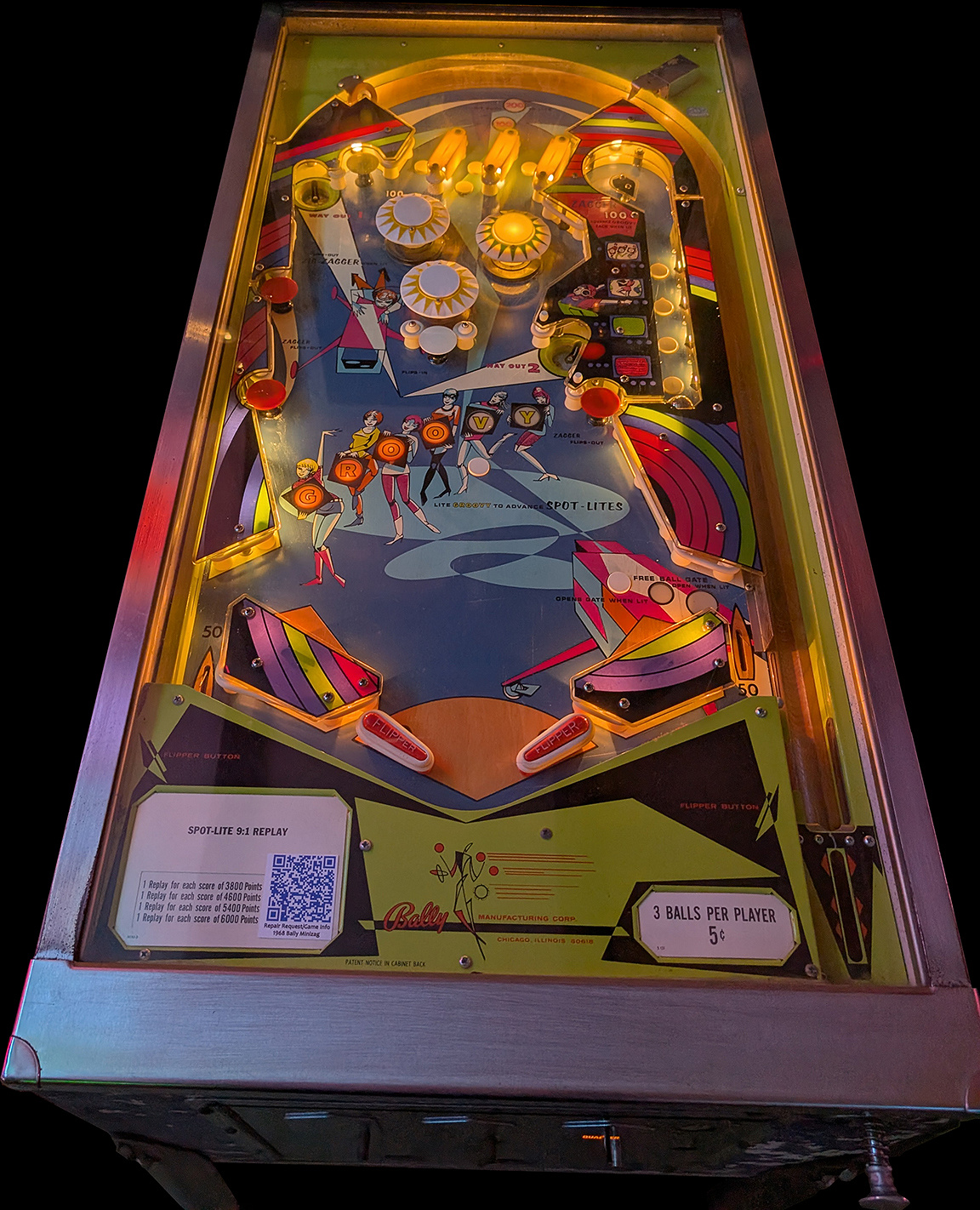
Fingerprint: Seven cartoon dancers striding left to right each holding orange octagonal tile, six tiles spelling G-R-O-O-V-Y, small jester in red-white pointed hat left of center, deeply curved chrome ball-guide arc sweeping from top center down right side, domed rotunda on pale blue ground
The single most memorable feature is a chorus line of seven cartoon dancers striding left to right across the middle of the playfield, each holding an orange octagonal tile, six of which spell G-R-O-O-V-Y. Second, a small jester in a red-and-white pointed hat stands left of centre under the words PLUMB LINE. Third, a deeply curved chrome ball-guide arc sweeps from the top centre down the right-hand side past the DROP TARGET bank. Fourth, a black lettered apron carries a cursive red company logo with MANUFACTURING CORP. and CHICAGO, ILLINOIS 60618 in small caps.
Setting
- Pale blue-grey painted ground
- Large grey-and-white domed building on a plinth at lower centre
- Sweeping red, yellow and green rainbow bands across the top of the board
- Abstract kite, bird and dart shapes scattered over the lower half
- Black lower apron panel carrying the manufacturer lettering
Symbols
- Six orange octagonal letter tiles
- Gold sunburst rings on the pop-bumper caps
- Wide rainbow bands
- Abstract kite and dart shapes
- A qr code printed on the replay card
- A small round 10c price plate
Notable shapes
- Large sweeping chrome ball-guide arc from top centre down the right edge
- Three triangular striped plastics flanking the lower playfield
- Arched rainbow bands forming a curve across the top
- Domed rotunda shape painted in grey and white at lower centre
- Flat white painted spot-lite discs scattered around the board
Art motifs
- Mod fashion cartoon dancers
- Mid-century airbrushed rainbow
- Spot-light circles painted as flat white discs
- Domed stadium or rotunda architecture
Themes
- Pop art
- 1960s mod fashion
- Abstract geometric pop
- Playfield spot-lites
Text on it
- 100
- ZAGGER
- CARRY-OUT
- ZAGGER CARRY-OUT
- WINNER WHEN LIT
- 100 C
- PLAY OUT 2
- LITE GROOVY TO ADVANCE SPOT-LITES
- SPOT-LITES
- FREE BALL GATE
- WHEN GATE LIT
- SPINNER GATE
- WHEN LIT
- FLIPPER
- FLIPPER BUTTON
- 50
- SPOT-LITE 9:1 REPLAY
- 1 Replay for each score of 3800 Points
- 1 Replay for each score of 4600 Points
- 1 Replay for each score of 5400 Points
- 1 Replay for each score of 6000 Points
- Report defective or missing pins on the playfield
- 3 BALLS PER PLAYER
- 5c
- 10c
- MADE IN U.S.A.
- PATENT NOTICE IN CABINET BACK
- MANUFACTURING CORP.
- CHICAGO, ILLINOIS 60618
- PLUMB LINE
| Kind | Description |
|---|---|
| Woman | Leftmost dancer, short blonde bob, white top and short pink skirt, striding pose, holding the tile lettered g |
| Man | Dancer in a bright orange top, dark trousers, holding the tile lettered r, arm raised |
| Man | Dancer in a yellow shirt with orange trim and dark trousers, holding the tile lettered o |
| Woman | Dancer in a pink top and red trousers, long hair, holding the tile lettered o |
| Man | Dancer in a dark suit with white shirt and dark tie, holding the tile lettered v |
| Man | Dancer in a maroon-and-white striped top and dark trousers, holding the tile lettered y |
| Woman | Rightmost dancer with red hair in a blue-green outfit, one leg kicked back, holding a tile lettered y |
| Other | Small jester or clown in a red-and-white pointed hat and ruffled collar, left of centre, beneath the words plumb line |
A 1960s electro-mechanical playfield in a wooden cabinet, shot at a steep angle with a bare aluminium lockdown bar at the near edge. The art is a flat mid-century airbrushed collage: a grey-and-white domed rotunda on pale blue ground at lower centre, wide red, yellow and green rainbow bands across the top, and abstract kite, bird and dart shapes over the lower half. Across the middle runs a line of seven flat cartoon dancers in mod clothing, each carrying an orange octagonal tile; six tiles carry the letters G-R-O-O-V-Y. Above them sit three white pop-bumper caps with gold sunburst rings beside a yellow cap, and four chrome posts with yellow sleeves cross the upper arch. The right side holds a vertical drop-target bank, while a curved chrome ball guide arcs from top centre down the right edge. Two red CHERRY-COLOUR flipper buttons flank an orange lower-deck panel. Legible print includes a white SPOT-LITE 9:1 REPLAY card with four replay scores and a QR code, a 3 BALLS PER PLAYER card, and CHICAGO, ILLINOIS 60618 under a red script logo.
Backglass vision analysis
Written by a machine from the photos, so details may be off.
Backglass
- blue
- red
- yellow
- green
Fingerprint: MINIZAG title in crimson capitals, black-faced figure with broad white toothy mouth and raised arms looming behind red-tunic man center-stage with arms thrown wide, crescent-shaped chain of large flat colour circles hanging from black triangular wedges along top tagged with pink numerals 7 to 1, yellow-costumed long-limbed figure with flowing plume, four identical youths in red blazers marching down right
A grinning black-faced figure with a broad white toothy mouth and raised arms looms behind a red-tunic man who stands centre-stage with arms thrown wide. A crescent-shaped chain of large flat colour circles (yellow, pink, green, orange, glittery red) hangs from black triangular wedges along the top, each tagged with a small pink numeral counting down from 7 to 1. A long-limbed yellow-costumed figure with an enormous flowing plume fills the lower left, next to a small crouching green-and-yellow figure. Four identical youths in red blazers and white caps march in a neat profile row down the right-hand side.
Setting
- Flat sky-blue field
- Black wedge shapes along the top
- Green hill or mound at lower left
- White counter strip at right
Symbols
- Row of flat colour circles in black wedges
- Small pink numerals 1-9
- Mechanical score reels
- Metal ball-guide rail
- Green mound
Lettering
- Tall condensed crimson-red capitals with a heavy black outline and slight hand-drawn wobble, preceded by a small white cursive signature
Themes
- Comic-strip
- Marching youths
- Villain
- Group of performers
- Hill
Title on it
- Minizag
Text on it
- MINIZAG
- Bally
- 7
- 6
- 5
- 4
- 3
- 2
- 1
- 8
- 9
- 0000
| Kind | Description |
|---|---|
| Man | Centre stage, black face-mask or dark skin with a wide grin, short dark hair, red long-sleeved tunic and red trousers, white belt, black boots, arms flung out to either side, head turned left |
| Monster | Large black silhouette directly behind the red-tunic man, spiky black outline, big white toothy grin, arms raised, reads as a sinister shadow figure |
| Man | Far left, bald or white-haired older man in a red top with white/grey trousers, leaning forward with both hands reaching |
| Woman | Left of centre in a tight yellow costume, enormous flowing yellow plume or swept hair arcing up and left, one arm out, one leg kicked back |
| Man | Lower left, small figure crouching on hands and knees on the green hill in a green and yellow costume, head down |
| Man | Right side, first of four identical youths in profile wearing red blazers, white shirts, grey trousers and white caps, marching leftwards with bent knees |
| Man | Right side, second of the four identical red-blazered marching youths in white cap |
| Man | Right side, third of the four identical red-blazered marching youths in white cap |
| Man | Right side, fourth and rearmost of the four identical red-blazered marching youths in white cap |
A painted, cartoon-style backglass in a wooden backbox, photographed behind glass with a hazy reflection across the top. The background is flat sky blue. Across the top edge runs a zig-zag banner of black triangular wedges, each holding one large solid colour circle, with small pink numerals beside them: yellow, pink, green, orange, glittering red, a pie-chart-like circle, and another pink, reading 7, 6, 5, 4, 3, 2, 1 with 8 and 9 stepping down the left side. Below and left of centre the title is lettered in tall, slightly irregular crimson-red capitals with a heavy black outline, set on a white hand, and a small cursive signature sits above the first letter. On the right is a white mechanical score-counter window showing four reels of zeros, with a metal ball-guide rail running diagonally above it. The centre is packed with figures: a black-masked grinning man in a red tunic and trousers with a white belt and black boots, centre stage, arms thrown wide; behind him a large black silhouette figure with a grinning white toothy mouth and raised arms; to the right four young men in matching red blazers, white shirts, grey trousers and white caps, marching in a row in profile; to the left a long-limbed figure in a yellow costume with a huge flowing yellow plume, a smaller crouching figure in green and yellow, and an older bald figure in red.